How the Heat 1995 Crime Epic Influences Sci-Fi Cinema

Introduction: Why a 1995 Crime Epic Matters for Sci-Fi Enthusiasts
Let’s be honest. If you love sci-fi, you probably watch a lot of movies. And somewhere in your recommended feed or a friend’s top ten list, you have seen one film pop up again and again: Heat.

A 1995 crime drama starring Al Pacino and Robert De Niro. No aliens. No spaceships. No time travel. So why should you care?
Here is the thing. The best sci-fi isn’t just about lasers and wormholes. The best sci-fi is about people. It is about obsession, consequence, and the thin line between order and chaos. Heat, directed by Michael Mann, delivers all of that with an intensity that few films in any genre can match. It marks the first joint on-screen appearance of acting titans Robert De Niro and Al Pacino, but that is only the surface.
What makes Heat essential for sci-fi fans is its DNA. This is a film that redefined modern action with its tactical realism and emotional depth. The famous street shootout scene is so raw and precise that filmmakers like Christopher Nolan studied it frame by frame before crafting their own action sequences. When you watch a battle scene in a sci-fi blockbuster and feel the weight of every bullet, the chaos, the fear, that is Heat‘s influence at work.
Sci-fi enthusiasts often crave grounded, character-driven stories. We want to see people making impossible choices in high-stakes worlds. Heat offers a pure distillation of those elements without the sci-fi veneer. It is a masterclass in tension, moral ambiguity, and the price of dedication. It is the training ground for understanding what makes a protagonist tick, whether that protagonist is a detective, a thief, or a starship captain.
In 2026, with so much content flooding our screens, understanding the roots of great storytelling matters. This article breaks down Heat‘s cinematic innovations, its influence on sci-fi blockbusters, and why it belongs in every serious fan’s watchlist. You might be surprised to see how much a 1995 crime epic has shaped the space operas and dystopian thrillers you love today.
If you want to explore more films that blend realism with spectacle, check out our guide on where to find free sci-fi movies on Tubi, Peacock, and other legal streaming sites. There is a whole universe of content waiting for you.
The Craft of Heat: Michael Mann’s Obsession with Authenticity
Let’s talk about why Heat looks and sounds nothing like a typical 1995 movie. It feels like you are standing right there on the street with Pacino and De Niro. That is not an accident. It is the result of Michael Mann’s absolute obsession with authenticity.
Mann came from documentary filmmaking. He did not just write a script and shoot. He wanted the real thing. He spent months doing ride-alongs with the LAPD.

He interviewed ex-convicts. He studied their language, their rituals, their paranoia. This deep research gave the film a texture you cannot fake on a studio lot. It is why the heat movie still feels so alive today. The real-world details are baked into every scene. If you want to explore more films grounded in realism, check out our recommendations for the best new sci-fi movies 2026 and TV shows you can’t afford to miss.
The Technical Choices That Changed Action Cinema
Mann insisted on using practical effects. When a bullet hits a wall in this film, real concrete chips fly. The actors fired real machine guns firing blanks for the famous bank heist scene. This forced everyone to react to real noise and real debris. Nothing was safe. Nothing was clean.
The sound team recorded dialogue live on the streets of Los Angeles. You can hear the echo of the city in the background. The editing team, led by a quartet of skilled editors, worked to preserve that chaotic, natural energy. The result is a violent, immersive experience that set a new standard for action filmmaking.
The downtown LA shootout is the crown jewel. It is not just a gunfight. It is a brutal sonic assault. Because they used real blanks, the sound has a sharp, echoing crack you rarely hear in movies. Director Christopher Nolan studied this scene frame by frame before making The Dark Knight. You can see the DNA of Heat everywhere in modern action blockbusters and even in Christopher Nolan movies that try to capture that same guttural realism. The film changed the playbook for everyone who came after.
Painting with Streetlights
The nighttime cinematography is pure genius. Mann and cinematographer Dante Spinotti often used only street lamps and car headlights as their light source. This created deep, inky shadows and pools of harsh, unforgiving light. It makes the characters feel like they are hiding in plain sight. You can see the dusty air, the sweat on their faces, the weariness in their eyes.
Watching the recent 4K Ultra HD Blu-ray release, you can see every detail of the film grain and the careful color grading. The transfer is stunning and lets you appreciate the craft at a whole new level. The cinematography alone is a masterclass in visual storytelling.
This commitment to reality is why Heat still matters in 2026. It proves that the best action comes from real stakes, real places, and real craft. It is a perfect example of a movie that respects its audience’s intelligence.
If you want to find more films that share this level of craftsmanship and dedication, use our Explore Guides to discover curated viewing orders and personalized recommendations. There is a whole universe of quality content waiting for you.
Heat’s Action Realism: A Blueprint for Sci-Fi Action Choreography
Now that we have seen how Michael Mann built Heat on a foundation of authentic craft, let us look at how that realism shaped modern sci-fi action. You might not think a crime drama from 1995 has much to do with aliens and spaceships. But here is the thing: the downtown LA shootout in this heat movie completely changed how directors film action in every genre, especially science fiction.
The Shootout That Rewrote the Rules
Before Heat, action scenes in sci-fi movies often looked clean and choreographed. Characters fired thousands of rounds without reloading. Bad guys waited their turn. Then Mann showed us what real combat looks like. He used spatial awareness. You always know where every character is in relation to everyone else.

The gunmen use cover. They reload with urgency. They communicate with hand signals.
This approach directly influenced Christopher Nolan. When he made The Dark Knight in 2008, he studied the Heat shootout frame by frame.
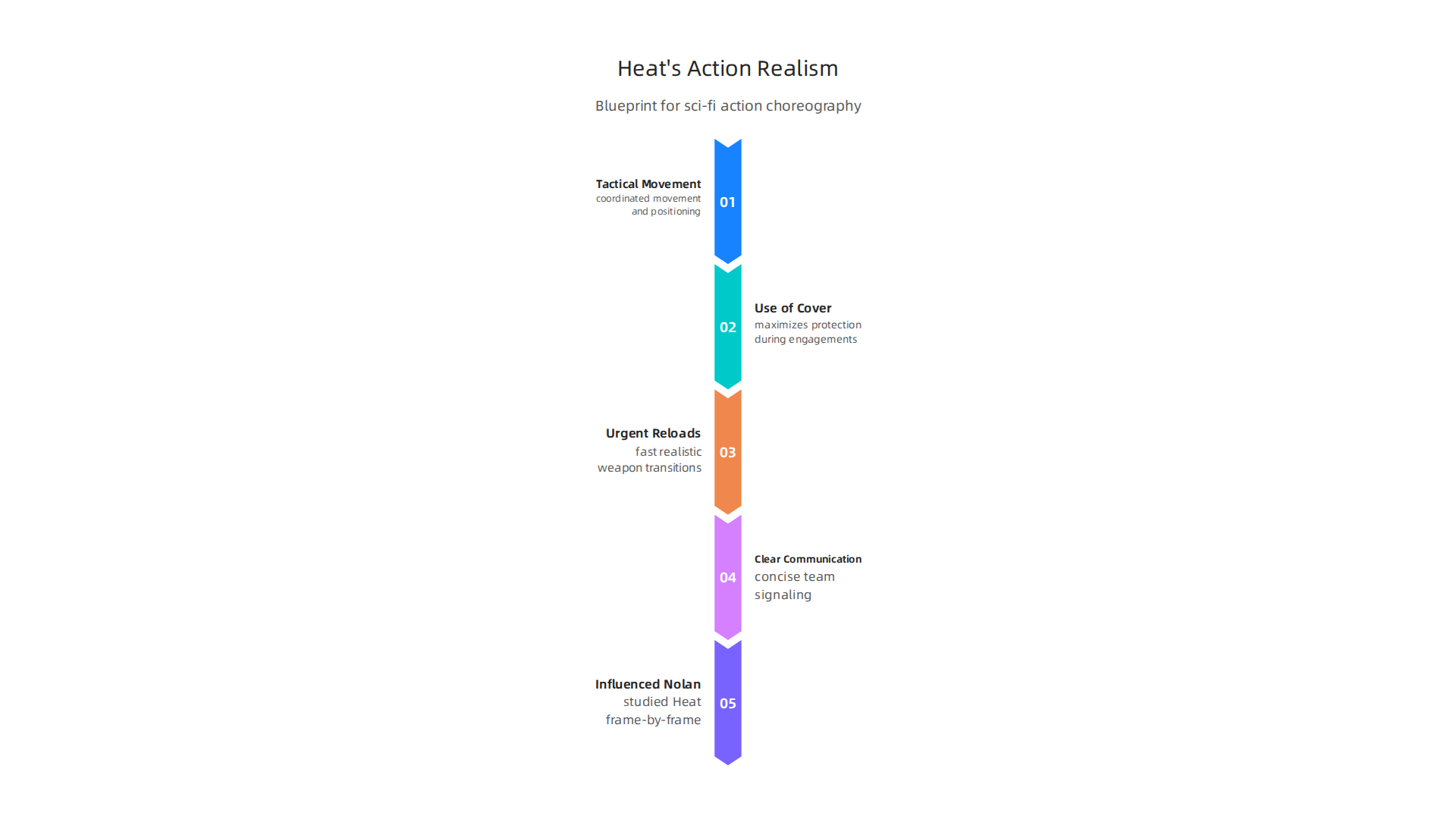
You can see it in the Hong Kong skyscraper sequence and the convoy attack. Nolan is widely considered one of the most talented directors of this century, and he has often credited Heat as a major influence on his action philosophy. The same goes for the John Wick series. Those films treat gunfights as tactical problems, not dance routines. The reloads, the suppressed weapons, the close-quarters movement, it all traces back to Mann’s blueprint.
Tactical Realism Meets Sci-Fi Warfare
The influence spread even further into military sci-fi. Movies like Edge of Tomorrow (2014) and District 9 (2009) use the same grounded approach. Soldiers move like real soldiers. Weapons jam. Ammo runs out. The tension comes from vulnerability, not firepower.
This shift toward verisimilitude marks a clear break from earlier sci-fi classics. In Star Wars, blaster bolts fly everywhere and nobody seems to take cover seriously. In The Terminator, Arnold Schwarzenegger walks through gunfire without breaking stride. Those films are fun, but they do not feel real. Heat taught filmmakers that audiences can handle the messy, chaotic truth of combat. It made sci-fi action smarter and more tense.
If you love action sequences that respect your intelligence, you will find plenty more where Heat came from. Check out our guide to the best new sci-fi movies 2026 and TV shows you can’t afford to miss for films that carry this same commitment to craft. And when you are ready to explore deeper, use our Explore Guides to find curated viewing orders and personalized recommendations across the entire genre.
Character Archetypes: The Cop and the Criminal in Sci-Fi
Heat did something rare. It made you care about both sides of the law. Pacino’s Vincent Hanna is obsessive and broken. De Niro’s Neil McCauley is cold but principled.
Neither is a hero or a villain. They are just men trying to survive in their own worlds. That moral gray area changed how sci-fi writers build their characters too.
The Criminal with a Code
McCauley lives by a simple rule: never get attached to anything you cannot walk away from in thirty seconds. That code isolates him. He cannot have real friends or a real home. Sound familiar? It is the same loneliness you see in Deckard from Blade Runner 2049. It is the quiet ache of Takeshi Kovacs in Altered Carbon. These sci-fi antiheroes push people away because connection means weakness. The heat movie taught screenwriters that a criminal’s internal logic can be more compelling than any futuristic gadget.
The Cop Who Loses Himself
Hanna is just as broken as McCauley. He chases criminals because he does not know what else to do with his pain. His marriage is falling apart. He has no hobbies. The job is his identity. Sci-fi adopted this too. Think about Detective Miller in The Expanse. He is a washed-up cop who only finds purpose when he starts chasing a missing girl. Like Hanna, he sacrifices everything for the chase. This kind of character feels real because we see their flaws first.
Shared Humanity Raises the Stakes
Here is where Heat truly shines. Both men want the same things. Family. Loyalty. A reason to keep going. McCauley tries to build a life with Eady. Hanna tries to save his marriage. Sci-fi works like Blade Runner 2049 use the same trick. K longs for a real connection. He wants to believe he matters. That emotional weight makes the action land harder. When a character risks something personal, you feel the tension in your chest.
Directors like Denis Villeneuve and Christopher Nolan, who is considered one of the most talented directors of this century, learned from Mann that genre stories need real people. If you enjoy character-driven sci-fi that respects emotional depth, check out our roundup of the best new sci-fi movies 2026 and TV shows you can’t afford to miss for more recommendations built on this tradition. When you are ready to dive deeper into characters that feel as real as Hanna and McCauley, Explore Guides offers curated viewing orders and franchise deep dives tailored to your taste.
Heat’s Influence on Sci-Fi and Action Cinema: A Legacy of Realism
You have probably seen Heat without knowing it. I do not mean in a theater. I mean in the DNA of almost every serious action or sci-fi movie made after 1995.
The film holds an 84% approval rating on Rotten Tomatoes, and critics call it vast and detailed. But its real legacy is not the score. It is the way it changed how stories are told.
The Slow Burn That Feels Real
Before Heat, most action movies followed a simple pattern. Setup, shootout, ending. Michael Mann did the opposite. His robbery scene takes nearly forty minutes to build. You watch the characters plan, argue, and sweat. The tension grows because you know them. That slow, patient structure now shows up everywhere. Think of Blade Runner 2049. Denis Villeneuve lets scenes breathe. You feel every second of silence. That is pure Heat. Christopher Nolan, whom many consider one of the most talented directors of this century, uses the same approach in films like The Dark Knight. He lets the story take its time. The audience waits. And that waiting makes the payoff hit harder.
Moral Ambiguity Opened New Doors
Heat refused to pick sides. The cops were flawed. The criminals had hearts. That gray thinking changed sci-fi forever. Suddenly, your hero could be a replicant who kills people. Your villain could be a father trying to save his family. Stories like The Expanse and Altered Carbon thrive on this moral mess. They would not exist without the road Heat paved. Directors like Chad Stahelski, who made John Wick, openly credit Mann for teaching them that action needs heart. His influence is scattered across the best new sci-fi movies 2026 and TV shows you love today.
How It Shifted Hollywood’s Gears
In the 2000s and 2010s, studios started taking more risks on grounded, character-driven genre films. Heat proved that audiences would sit through a long conversation if the characters felt real. That lesson powered everything from Sicario to Dune. The old way of nonstop explosions gave way to deliberate pacing. That is why you now see sci-fi on streaming platforms that feels more like a drama. The legacy of Heat is not just in shootouts. It is in the quiet moments where people decide who they really are.
If you want to track down more movies that carry this realist torch, check out our guide to free sci-fi movies on Tubi, Peacock, and legal streaming sites. You might find the next film that changes your view of the genre.
Your Next Step into Deeper Stories
You now see how one 1995 film shaped the best sci-fi of today. But there is more to explore. Explore Guides offers curated viewing orders and franchise deep dives. It is the perfect place to go next if you want stories with the same emotional weight as Heat.
Why Sci-Fi Fans Should Embrace Heat: Cross-Genre Appreciation
If you love sci-fi but have never watched Heat, you might think it has nothing to offer you. That is a mistake. Here is the thing: some of the best lessons for sci-fi storytelling come from outside the genre entirely. And Heat is the perfect example.
Los Angeles as a Living Character
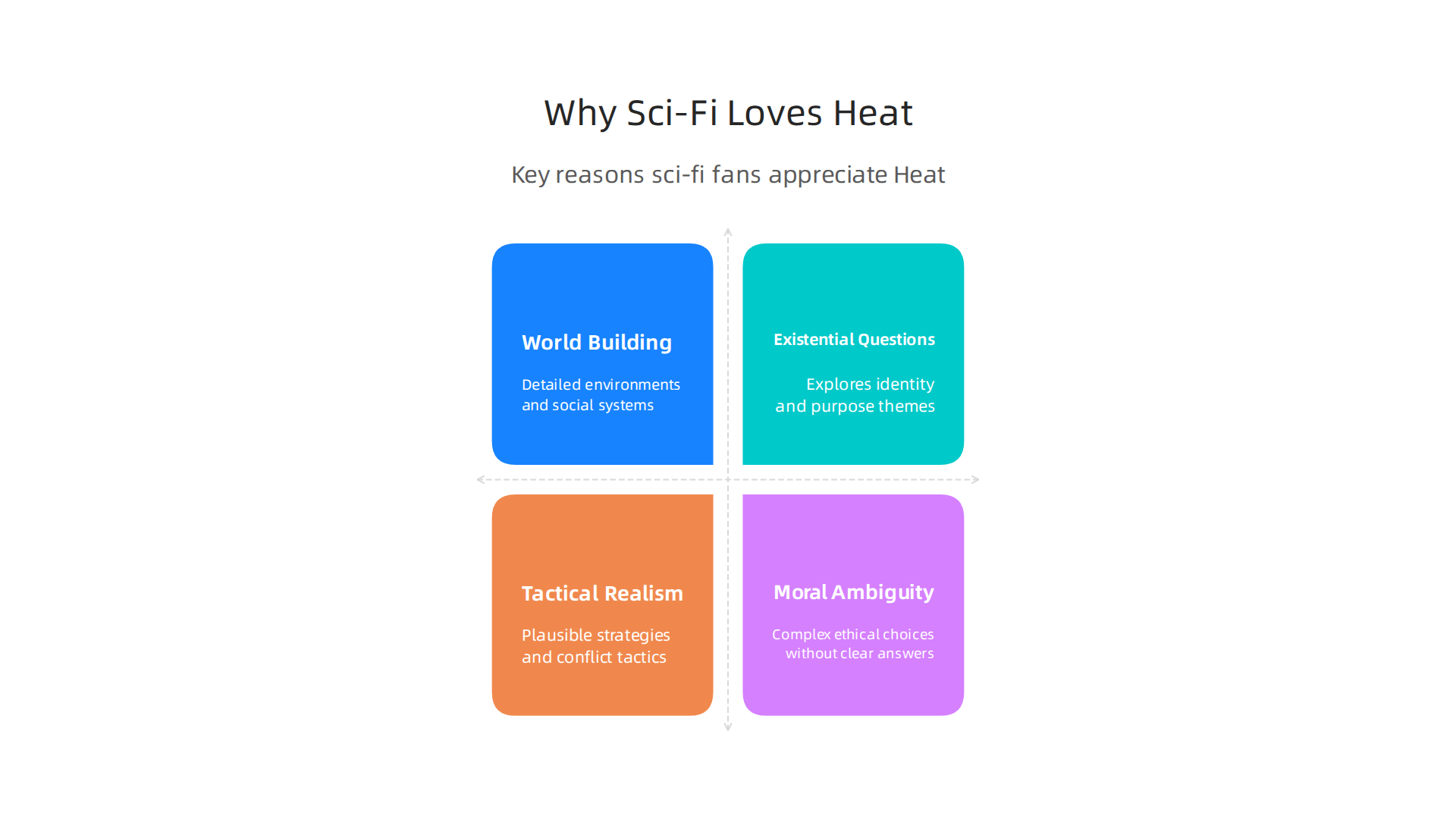
You already know that the best sci-fi, like Blade Runner, makes its city feel alive. The rain, the neon, the endless towers. That is world-building. But Heat does the same thing with 1995 Los Angeles. The freeways are vast. The industrial yards are cold. The suburbs feel empty. Michael Mann turns LA into a breathing character that shapes every scene. When you watch a sci-fi movie and the setting tells the story, that skill came from movies like Heat. If you want to see other character-driven worlds, check out the best new sci-fi movies 2026 and see how much they owe to this grounded approach.
Existential Questions Without the Spaceship
Sci-fi loves big questions. What does it mean to be human? Are we just biological machines? Heat asks the same things, just without the aliens. Neil McCauley lives by a strict code that isolates him from everyone. Vincent Hanna stares into the dark and wonders if his work is all he has. These are the same existential struggles you find in Westworld or The Expanse. The difference is the setting, not the soul. A 2025 survey of film trends noted how modern audiences crave stories that explore deeper concerns, and Heat delivered that years before the best sci-fi movies of 2025 made it mainstream.
Tactical Realism Feeds the Tech-Hearted
Are you a fan of military sci-fi? Do you love watching characters use gear that actually works? Heat is your film. The criminals use real weapons. They plan heists like actual operators. The famous downtown shootout is so precise that real SWAT teams have studied it. When you watch a movie like Sicario or John Wick and feel the weight of every reload, that is Heat talking. It proves that realism in action makes the stakes feel higher, even without a spaceship in sight.
Why You Should Watch It Right Now
Heat is not a sci-fi movie. But it teaches sci-fi fans what makes a story stick. World-building. Moral weight. Real stakes. If you love exploring the edges of humanity, you will love Heat. And if you want to find more films that bridge genres, check out our guide to free sci-fi movies on Tubi, Peacock, and legal streaming sites. You might discover the next movie that changes how you see the genre.
Ready to dive deeper into the stories that define modern sci-fi? Explore Guides offers curated viewing orders and franchise deep dives. It is the best way to find your next great watch.
How to Watch Heat: Editions, Restorations, and Viewing Experience
So you are ready to watch Heat. But here is the thing: not every version of this film looks or sounds the same. The way you watch it changes how much the movie hits you. Let me walk you through your options so you get the best experience possible.
The 1995 Original and the 2025 Restoration
Heat first hit theaters in 1995, directed by Michael Mann. It marked the first on-screen meeting of acting legends Robert De Niro and Al Pacino.

The film was a landmark for its realistic action and deep characters.
Fast forward to 2025. Mann personally supervised a new 4K restoration of Heat. This version improved the color grading and refined the sound mixing. The image is sharper and more natural than ever. According to a detailed review on The Digital Bits, the 4K release delivers a highly immersive audio experience that adds real depth to every scene.
Is There a Director’s Cut?
A lot of fans ask this question. The short answer is no. There is no official director’s cut of Heat. However, the Blu-ray and 4K releases include some extended scenes that give more context to character moments. These scenes are not part of a separate cut. They are extra material. The main film runs about 172 minutes, with a standard 2.40:1 aspect ratio.
What Is the Best Way to Watch?
For the full experience, you want the 4K UHD Blu-ray with HDR10 and Dolby Atmos sound.
This format lets you hear every detail of the famous downtown shootout. The sound design in Heat is so precise that it changes how you feel the tension. A comparison review on Blu-ray.com confirmed that the 4K version delivers stunning video and audio quality.
If you do not have a 4K setup, the standard Blu-ray is still a good option. Just know that the older Blu-ray release had contrast issues that were fixed in the 4K version.
Streaming vs. Physical
If you prefer to stream Heat, check which platform offers the highest quality version. Not all streaming services use the 2025 restoration. For more ways to find great films across genres, check out our guide to free sci-fi movies on Tubi, Peacock, and legal streaming sites.
Final Viewing Advice
Watch Heat on the biggest screen you have. Turn up the sound. Pay attention to the quiet moments between the action. That is where the real heat lives.
Ready to discover more stories that cross genres? Explore Guides offers curated viewing orders and franchise deep dives to help you find your next great watch.
Summary
This article argues that Michael Mann’s 1995 crime epic Heat matters deeply to sci‑fi fans because it defined a realist, character‑first approach that modern genre filmmakers still borrow. It explains how Mann’s documentary‑level research, use of practical effects, live sound recording, and night‑time cinematography created an immersive action language that rewired how shootouts and tense set pieces are staged. The piece traces Heat’s influence on directors from Christopher Nolan to the creators of John Wick and military sci‑fi, showing how tactical realism, slow‑burn pacing, and morally ambiguous protagonists crossed into futuristic storytelling. You’ll learn specific technical choices that changed action cinema, how Heat reshaped cop/criminal archetypes used in sci‑fi, and why the film’s legacy matters for world‑building and emotional stakes. The article also walks through editions and restorations—explaining why the 2025 4K restoration is the preferred way to watch—and gives practical viewing tips so you get the fullest experience. By the end you’ll understand Heat’s cinematic DNA and how to spot its fingerprints in contemporary sci‑fi.