The Rise Fall and Resurgence of M. Night Shyamalan Movies
The Man Behind the Twist: Why Shyamalan’s Career Matters
Few filmmakers spark a debate as intense as M. Night Shyamalan. He burst onto the scene with The Sixth Sense, a film that still holds a special place in movie history.

That movie was not just a hit. It was a cultural moment. But then came a string of films that left many people scratching their heads. Movies like The Village and The Happening earned low scores from critics, and fans started to wonder what had gone wrong, according to Rotten Tomatoes.
Here’s the thing. Shyamalan’s career is a roller coaster. And that is exactly why it matters. He showed us that a single director can make both masterpieces and misfires. He also proved that a comeback is possible. His filmography is a case study in high ambition, bold ideas, and the occasional misstep.
The problem is that it is hard to know which of his movies are worth your time. Some are brilliant. Others are confusing. This guide is here to help you sort through them all. We will look at each phase of his career using critical scores, box office data, and a close look at his themes. By the end, you will know exactly which m night shyamalan movies to stream and which to skip.
His journey is fascinating, especially when you compare it to other directors who blend genres. For a deeper look at how unique storytelling shapes sci-fi and fantasy, check out this guide on Steven Spielberg sci-fi movies.
Both directors share a love for the unexpected.
If you enjoy stories that bend reality and challenge your perspective, you might want to follow the whole universe of the Ridiculous series. It is the perfect next step for fans of twisty, fun narratives.
The Early Years: From Praying with Anger to The Sixth Sense
Before the world knew his name, M. Night Shyamalan was just a young filmmaker with a big dream. He made his first feature, Praying with Anger, back in 1992. It was a personal story about a young man visiting India, but it barely got noticed. The film holds a very low score on Rotten Tomatoes, and most people have never heard of it. That is okay. Every great director has to start somewhere.
Then came Wide Awake in 1998. This one was a gentle comedy-drama about a boy searching for meaning after his grandfather dies. It was Shyamalan’s first studio film, but it did not find an audience. Critics were kind of lukewarm. Looking back, these early movies show that Shyamalan was still finding his voice.
But everything changed in 1999.
The Sixth Sense hit theaters and became a global sensation. Bruce Willis plays a child psychologist, and Haley Joel Osment plays a little boy who sees dead people. The twist ending is so famous that people still talk about it today. The movie earned six Academy Award nominations and made over $672 million worldwide against a small budget. According to Rotten Tomatoes’s ranked list of all Shyamalan films, The Sixth Sense remains one of his highest-rated movies. Its Tomato score sits at a strong 86%, and audiences gave it 87%.
This film did something special. It proved that slow-burn tension could work in a mainstream thriller. Shyamalan used long takes and quiet scenes to build unease, a technique he would carry into his later work. As one analysis of his directing style explains, he relies on carefully choreographed camera movements to create suspense (StudioBinder).

The Sixth Sense is one of the best movies to stream if you want to see pure storytelling mastery. It is available on most platforms.
If you enjoy films that twist your expectations and make you think, you should follow the whole universe of the Ridiculous series. It is a great next stop for fans of playful, surprising narratives.
The Golden Era: Unbreakable, Signs, and The Village
After the massive success of The Sixth Sense, M. Night Shyamalan could have played it safe. Instead, he pushed himself into new territory. Between 2000 and 2004, he delivered three movies that defined his golden era. Each one tried something different. And each one left a mark on m night shyamalan movies history.
Unbreakable (2000): A Superhero Story with No Costumes
Unbreakable came out just one year after The Sixth Sense. It starred Bruce Willis again, this time as David Dunn, a man who survives a train crash with zero injuries. Samuel L. Jackson played Elijah Price, a comic book fan with a rare bone disease.
This movie flipped the superhero idea upside down. There were no capes or explosions. Instead, Shyamalan asked a quiet question: what if a real superhero existed in our world? The film used long, still shots to build tension. You can see that technique in many of his movies, and it is a big part of his directing style.
At first, audiences were not sure what to think. But over time, Unbreakable grew into a cult classic. Fans now see it as one of the most thoughtful superhero films ever made. It is definitely one of the best movies to stream for anyone who loves slow-burn mysteries.
Signs (2002): Faith Meets Aliens
Signs took a different turn. It told the story of a farmer (Mel Gibson) who finds crop circles in his field. The movie mixed alien invasion with a deep struggle about faith and family.
The box office loved it. Signs earned over $400 million worldwide. Critics praised the way Shyamalan used everyday objects to create fear. There is a famous scene where a family watches news footage of an alien walking past a birthday party. The camera stays still for a long time. You just wait for something to happen. That slow burn is pure Shyamalan. You can learn more about his long-take technique in a deep dive of his visual style (Offscreen).
The Village (2004): A Bold Experiment
The Village was maybe the most daring of the three. Set in a small 19th-century community, the movie followed people who lived in fear of monsters in the woods. The cast included Bryce Dallas Howard, Joaquin Phoenix, and Sigourney Weaver.
Critics were split. The film got a 43% score on Rotten Tomatoes from critics, but audiences liked it a bit more at 57% (Complex). It earned $256.7 million at the box office, which is still a solid number. The twist at the end made people argue for years. Some loved it. Others hated it. But you cannot deny that Shyamalan took a big swing. He tried to blend a period drama with a horror thriller.
These three movies show Shyamalan at his most creative. He was not afraid to mix genres and challenge expectations. If you enjoy directors who take risks, you might also like the work of Steven Spielberg in the sci-fi space. Check out this guide to Steven Spielberg sci-fi movies to see another master of suspense.
And if you love stories that surprise you, you should follow the whole universe of the Ridiculous series. It is full of twists, humor, and unexpected turns.
The Difficult Years: Creative and Commercial Slump (2006–2013)
But after that golden run, things took a sharp turn. Between 2006 and 2013, M. Night Shyamalan released four movies that nearly destroyed his reputation.
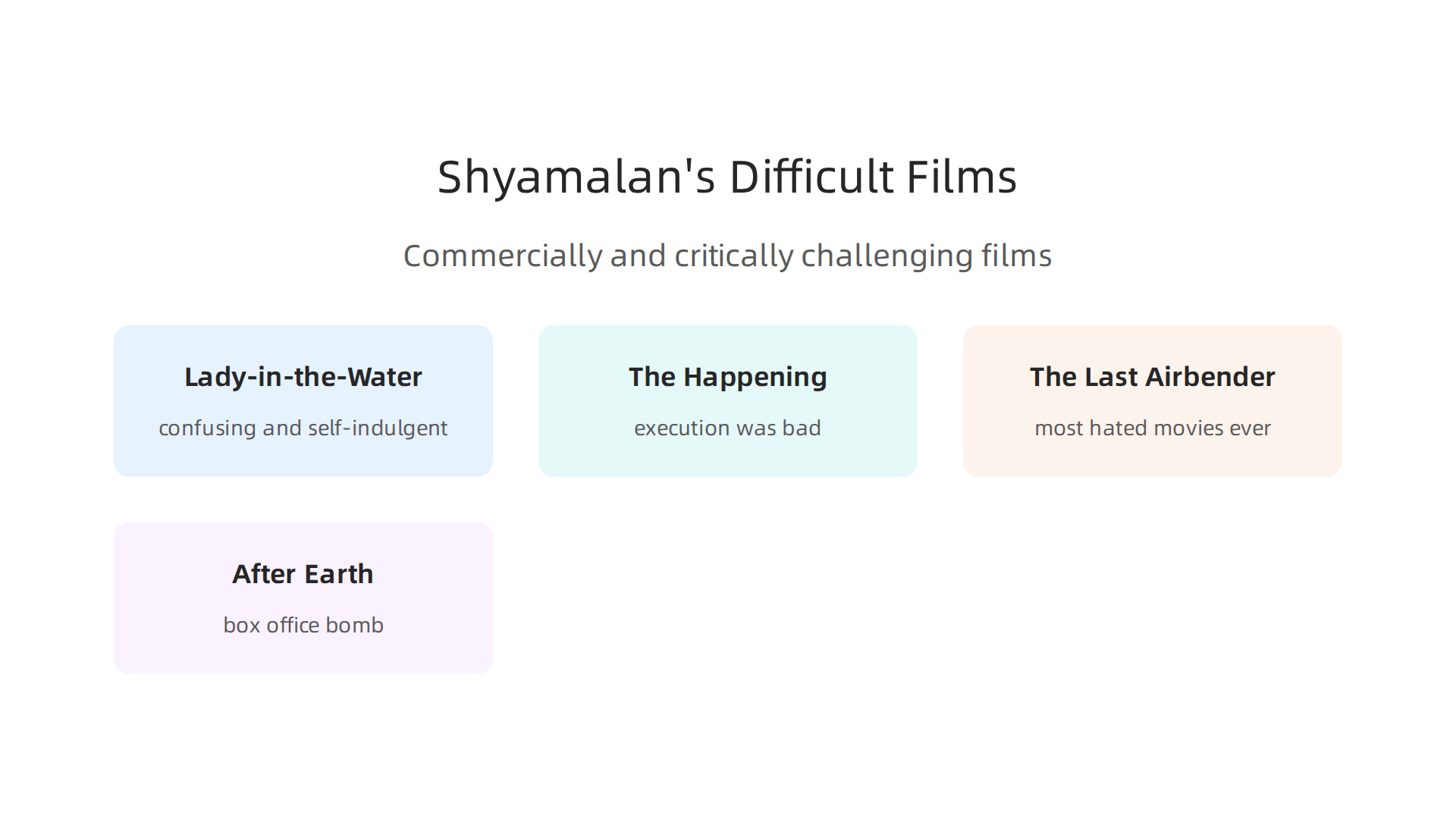
Critics were brutal. Audiences stayed away. Many people thought his career was over.

It started with Lady in the Water (2006). This fantasy story about a water nymph and an apartment building super fell flat. It has a 25% score on Rotten Tomatoes (Business Insider). The movie was confusing and self-indulgent. Fans who loved The Sixth Sense had no idea what to make of it.
Then came The Happening (2008). A thriller about people suddenly killing themselves because of a toxin in the air. Sounds creepy, right? But the execution was bad. The acting felt wooden. The plot made little sense. It scored only 18% on Rotten Tomatoes, per Collider. People started to wonder if Shyamalan had lost his touch.
The real disaster hit in 2010 with The Last Airbender. This was supposed to be a big-budget adaptation of a beloved Nickelodeon cartoon. Instead, it became one of the most hated movies ever. It has a 5% Rotten Tomatoes score. Fans of the original show were furious. Whitewashing, bad dialogue, and a rushed story killed any chance of success. Many critics call it one of the worst adaptations of all time. If you want to see how adaptations can go right, take a look at this guide to Stephen King books.
Finally, After Earth (2013) came out. Starring Will Smith and his son Jaden, this sci-fi adventure earned a 12% score on Rotten Tomatoes. It was a box office bomb and a creative mess. Shyamalan had lost all his momentum.
For about seven years, the magic was gone. People wrote him off. But Shyamalan did something unexpected. He went small. He went personal. And he came back.
If you enjoy stories that take wild risks even when things look bad, you might want to begin the absurd adventure that laughs at reality.
The Resurgence: The Visit, Split, and the Unbreakable Trilogy
After those dark years, most people thought M. Night Shyamalan was done. But he didn’t give up. He went back to basics.
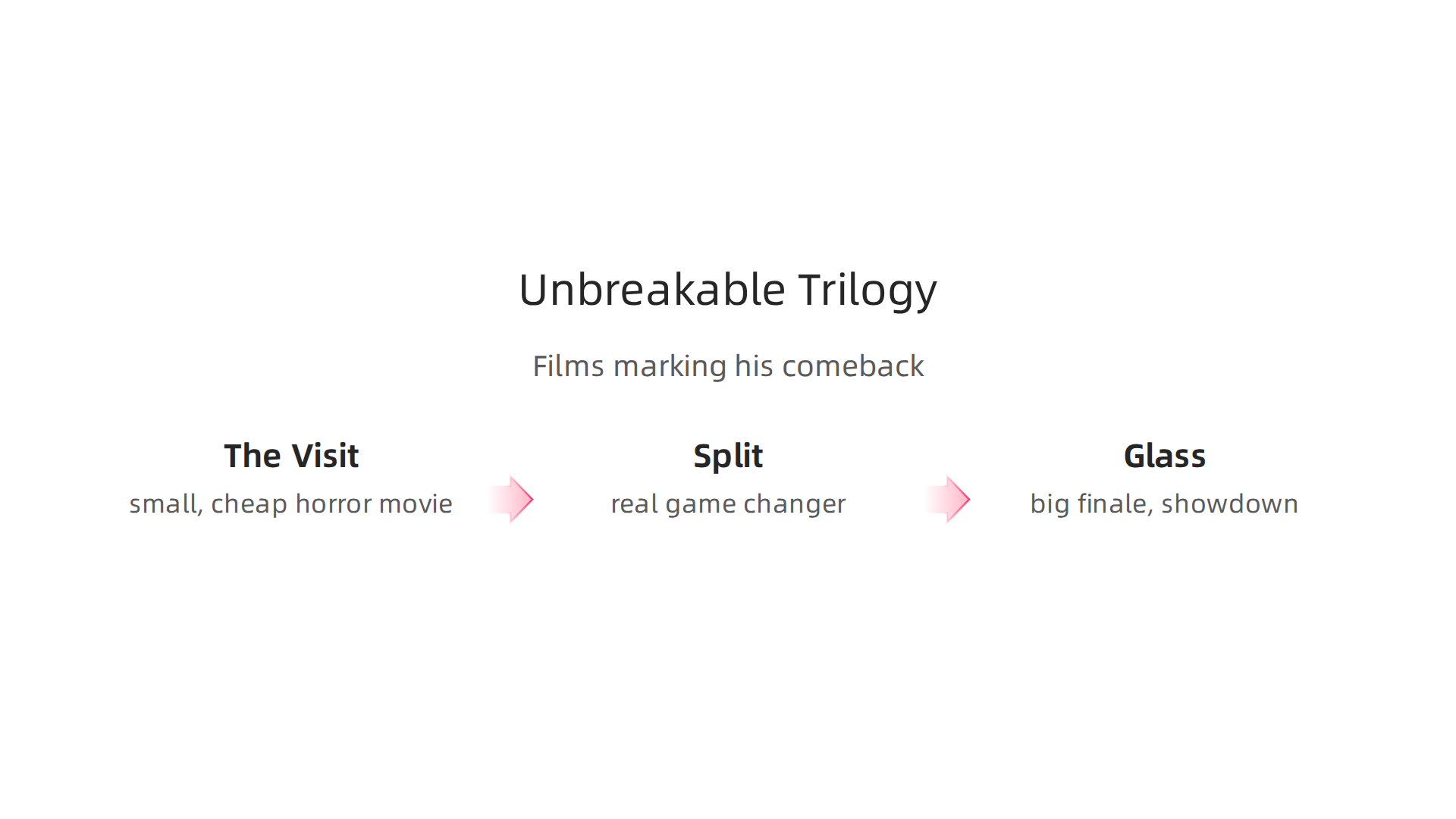
He made a small, cheap horror movie with no big stars. And it worked.
The Visit (2015) was a found-footage film about two kids visiting their creepy grandparents. Shyamalan funded it himself with a tiny budget of just $5 million. The movie looked raw and real. Critics liked it. Audiences were scared. It earned over $98 million worldwide. According to Business Insider, it got a 68% score on Rotten Tomatoes, a huge jump from After Earth. Suddenly, people were talking about M. Night Shyamalan movies again.
This low-risk gamble paid off. It reminded everyone that Shyamalan could still tell a tight, unsettling story. He didn’t need a giant budget. He just needed a good twist.
Split (2016) was the real game changer. James McAvoy played Kevin, a man with 23 different personalities who kidnaps three teenage girls. The performance was electric. The tension was thick. When the final twist hit, audiences gasped. It turned out that Split takes place in the same world as Unbreakable. Yes, Bruce Willis’s character, David Dunn, appears in the final scene. Shyamalan had secretly created a trilogy without telling anyone.
Split was a massive hit. It made over $278 million on a $9 million budget. It’s now considered one of the best movies to stream if you love psychological horror. Even casual fans started searching for “m night shyamalan movies” again.
Then came Glass (2019), the big finale. It brought together David Dunn, Kevin Wendell Crumb, and Elijah Price (Mr. Glass) for a showdown. The movie earned over $247 million worldwide. Critics were split on it, but fans loved seeing the story close. While not perfect, Glass showed Shyamalan could finish what he started.
This comeback proved one thing: creativity can outlast failure. Shyamalan learned from his mistakes and rebuilt his career step by step.

If you want to see more actors who defined this kind of bold filmmaking, check out this guide to iconic sci-fi actors who defined the genre.
Want to explore the full universe of twists and hidden connections? Follow the whole universe and discover more stories that keep you guessing.
The New Phase: Old, Knock at the Cabin, and Trap
After the success of Glass, Shyamalan kept doing things his own way. He didn’t chase big budgets or make sequels. He just kept making original stories. And that risk paid off again.
Old (2021) was a wild idea. A beach makes everyone on it age super fast. Parents turn elderly in hours. Kids grow up in minutes. The concept was so strange that critics didn’t know what to think. According to the official ranking of all m night shyamalan movies on Rotten Tomatoes, Old landed somewhere in the middle. But here’s the thing: audiences still showed up. The movie made over $90 million worldwide. That’s a win for any original film. It proved that people still want weird, creative ideas on the big screen. It also makes Old one of the more interesting best movies to stream if you want something truly different.
Knock at the Cabin (2023) was a total shift. It was small, quiet, and deeply scary in a different way. A family at a remote cabin meets four strangers. The strangers say the world will end unless the family makes a terrible choice. That’s it. One location. A handful of actors. Pure tension. The movie opened with $14.1 million in its first weekend, according to Box Office Mojo. Critics praised it. Audience reviews on Rotten Tomatoes were strong too. This movie reminded everyone why Shyamalan is one of a kind.
Trap (2024) went in yet another direction. Josh Hartnett plays a serial killer at a pop concert. The police have set the whole event up to catch him. It’s tense, clever, and full of close calls. Early critic reviews on Rotten Tomatoes show audiences enjoying this fresh setup. It keeps you guessing until the very end.
What stands out about this phase is Shyamalan’s commitment to originality. He is making movies that only he could make. In a world full of reboots, that matters. If you enjoy directors who take creative risks, check out this guide to Steven Spielberg’s sci-fi movies for more bold storytelling.
Want a story that twists reality? Begin the adventure with a series that bends the rules.
Signature Style and Recurring Themes
Now that we have looked at his recent movies, it helps to understand what makes an M. Night Shyamalan movie feel like his movie. You can spot his style even without knowing who directed it. It is more than just a surprise ending.
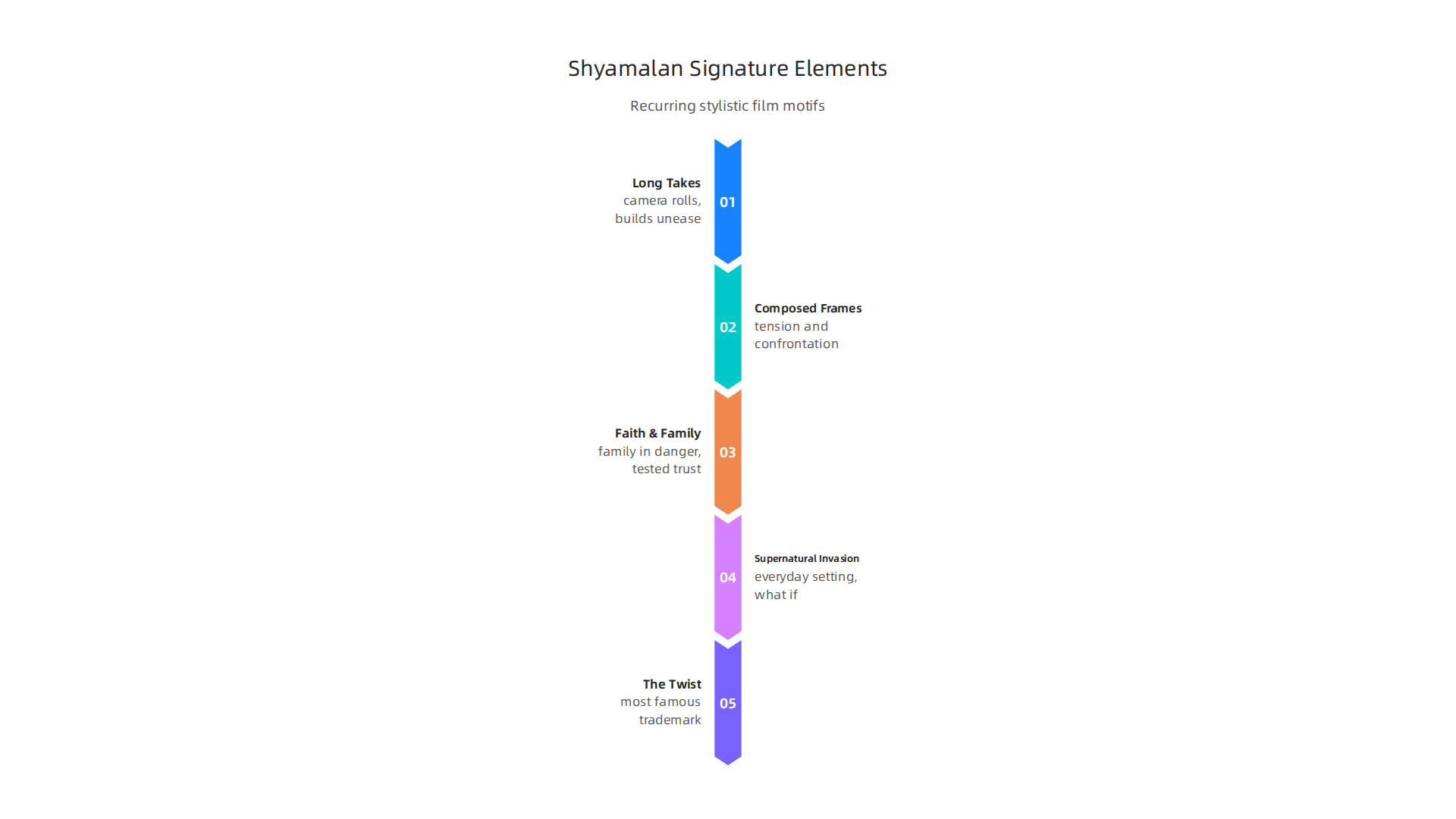
It is the way the camera moves, the way the story unfolds slowly, and the big ideas hiding under the surface.

Shyamalan loves long takes. Instead of cutting around, he lets the camera roll. A deep dive into his directing style shows that working in suspense makes a long take almost necessary. You cannot look away. Think of the beach in Old or the cabin in Knock at the Cabin. The camera stays with the characters. You feel the heat. You feel the panic. He also composes his frames carefully. Characters often face each other directly. An analysis of his visual style points out that this kind of blocking creates a strong feeling of tension and confrontation. Every detail feels planned to keep you off balance.
His movies also share common themes. They keep coming back to faith and family trauma. A family is usually in danger, and their trust in each other gets tested. The supernatural often invades an everyday setting. A normal beach. A normal city. A normal concert. He loves to ask: what if the world you trust is lying to you? The unreliability of perception is a huge part of his work. We see what the characters see, but it might not be real.
And yes, we have to talk about the twist. It is his most famous trademark. Some twists work beautifully, like in The Sixth Sense. Some get criticized. But every single one of his films tries to earn that final reveal. The ranked list of all m night shyamalan movies from Rotten Tomatoes shows how audiences react differently to each twist. Love them or hate them, they keep people talking. Understanding his style makes watching his movies even better. You start to see the clues he leaves behind.
If you enjoy directors who build entire worlds with unique visual rules, check out this guide to the best new sci-fi movies of 2026. These films push boundaries in similar ways. And if you love stories that question reality itself, you can follow the whole universe of creative content that waits for you.
M. Night Shyamalan Movies: A Critical and Cultural Legacy
Shyamalan’s career is a wild ride. He made a masterpiece with The Sixth Sense, then stumbled through big-budget misfires. You can see the full story in a ranked list of all m night shyamalan movies on Rotten Tomatoes. The highs are incredibly high, and the lows, like The Last Airbender with a 5% score, are brutal. But here is the thing: he never quit. That takes guts.
What makes his legacy special is not the box office numbers. It is the way he kept making original, high-concept films when Hollywood wanted sequels. He funded his own movies. He stood by his vision. A deep look at his career from SlashFilm calls it one of the most fascinating and bumpy filmographies in Hollywood. He earned that label.
His influence shows up everywhere. A whole generation of horror and thriller directors now use slow burns and quiet tension. You see his fingerprints in movies like A Quiet Place and The Visit. They borrow his tricks: long takes, family trauma, and a twist that changes everything.
Some fans defend him fiercely. A VICE article talked to people who love his work even after the tough years. They say he does not need defending. He just makes the movies he wants to make. That honesty matters.
If you enjoy directors who take big risks and build strange worlds, check out this guide to the best new sci-fi movies of 2026. These films carry that same spirit. And if you love stories that play with reality and throw in a good twist, begin the absurd adventure that laughs at reality and bends perspective. Shyamalan would probably approve.
Summary
This article traces M. Night Shyamalan’s up-and-down career from his obscure early films to the cultural phenomenon of The Sixth Sense, through a golden stretch with Unbreakable and Signs, a painful slump of commercial flops, and a resilient comeback that includes The Visit, Split and Glass, followed by a fresh, risk-taking phase with Old, Knock at the Cabin and Trap. It explains how his signature techniques—long takes, slow-burn pacing, family and faith themes, and surprise endings—shape audience reactions, and uses critical scores and box office data to show which films endure and which faltered. You’ll get clear guidance on what to stream, what to skip, the best watch order for connected films, and why his creative risks matter in modern genre cinema. The piece also places Shyamalan in a broader context of directors who push genre expectations and highlights his cultural legacy and influence on newer filmmakers.